
30 Apr

Implied Cuts are Dead. A Summer Hike: Very Much Alive

General

Posted by: Cedric Pelletier

Bond yields rocketed higher on Wednesday as oil prices surged and central banks signalled a growing willingness to tighten if inflation broadens.

Markets are now aggressively repricing policy expectations—most notably in Canada, where rate cuts have vanished without a forwarding address, and a summer hike is back in play.


Yield Movers

Wednesday’s news flow drove yields:

  • Higher: The BoC maintained its 2.25% overnight rate for the fourth straight meeting, right on cue.  The central bank sees “little evidence” of high oil prices driving persistent inflation, but that’s only because oil shocks can take multiple months to filter through to core prices. Governor Macklem warned that if price increases become more widespread, “there may be a need for consecutive increases in the policy rate.” MLN provided the rate context here.

Canadian and U.S. Policy Rates
Apr 21Apr 260.00%2.50%5.00%

Overnight Target
Fed Funds Target


  • Higher: As unanimously predicted, the Fed left its policy target at 3.50% to 3.75%, though the decision was the most divided in decades. Three policymakers objected to the “inclusion of an easing bias in the statement at this time.”  MLN unpacked that news here.
    ​ ​ ​
  • Higher: WTI prices ripped higher yet again, with spot WTI crude up 6.8% to $110.47 on deadlocked U.S.-Iran negotiations. Crude looks destined for multi-year highs, barring divine intervention. Oil has rallied almost nonstop since April 17, when Trump said the Strait of Hormuz was “fully open and ready for business and full passage,” a statement that aged about as well as you’d expect.
    ​ ​ ​
    News also broke that Trump met with top oil firms about the possibility that the blockade could last months. “They discussed the steps President Trump has taken to alleviate global oil markets ​and steps we could take to continue the current blockade for months if needed and minimize ⁠impact on American consumers,” said the White House.

    “Oil is driving the repricing in the rates curve. The market is highly concerned that the U.S. is committed to a long-term blockade.”

    –Adam Button | chief currency analyst, investingLive

  • Higher: U.S. core capital goods orders increased 3.3% in March, shattering forecasts (est. +0.5%, prior +0.7%). The AI investment boom continues to bolster business spending on equipment and infrastructure.
    ​ ​ ​
    “The stunning degree ⁠of strength during a month when firms would have had valid reason to be cautious attests to the substantial energy in business investment that was bottled up last year due to policy-related uncertainty,” noted Stephen ​Stanley, Santander U.S. Capital Markets.

Curve Chronicles

Today’s mortgage headline is the abrupt shift in policy expectations for the Bank of Canada.

OIS traders have completely erased rate-cut odds and are now eyeing a 50% chance of a July hike. All markets needed was a reminder from the BoC that a tightening bias is possible.
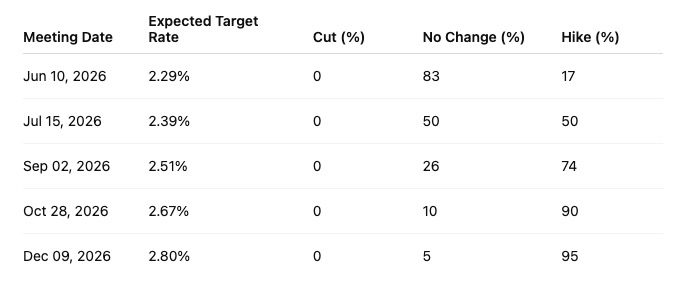
Source: LSEG (NOT FOR REPUBLICATION)
OIS-implied BoC Policy Rate Path (Source: LSEG) — NOT FOR REPUBLICATION

Expect the outlook to swing wildly over the coming weeks as markets digest Trump’s war moves and as energy costs work their way through the system.

For now, though, the direction is clear: a surging CPI is bullish for the mortgage rate outlook, and that’s exactly the kind of clarity borrowers were hoping to avoid.


Quote Board

The 5-year yield is opening 2 ticks lower this morning at 3.24%.

Funding cost indicators closed strongly higher on Wednesday:

Policy Probabilities

Here’s how markets are pricing in future policy this morning:

  • For the Bank of Canada meeting on June 10:
    • 25 bps hike: 18% chance
    • No change: 82% chance
  • For the Federal Reserve meeting on June 17:
    • 25 bps cut: 4% chance
    • No change: 96% chance

Written by the team at MLN

26 Apr

Cedric Pelletier – BNI Feature Presentation

General

Posted by: Cedric Pelletier

Excited to announce our next Feature Speaker at BNI Revolution – Sherwood Park!

This Tuesday, we’re learning from Cedric Pelletier, Mortgage Associate with the Maximal Mortgages Team – Part of the DLCG, The #1 Mortgage funding company in Canada.

Cedric will be the value add he brings to the table as a broker, and how he can help people save thousands.

If you’re looking to expand your knowledge, grow your network, or simply connect with driven professionals to grow your business with referral, this is your opportunity!

📅 Tuesday, April 28
💻 Online Meeting — open to all ⏰ 11:30 AM start
Come ready to learn, connect, and grow.

DM for a link to join!

24 Apr

Affordability overtakes trade as Canadians’ top economic concern

General

Posted by: Cedric Pelletier

Bank of Canada survey shows housing costs and job security now outweigh tariff fears, as Ottawa shifts focus back to domestic pressures

Housing affordability crisis

Housing affordability has overtaken trade tensions as Canadians’ top economic concern, according to the latest consumer expectations survey from the Bank of Canada.

The U.S. trade conflict, which dominated sentiment a year ago, now ranks well behind concerns about inflation, job security and emerging risks tied to artificial intelligence.

“What’s really interesting over the last few months is that [President] Trump has actually really receded from the list of issues that Canadians are concerned about,” CTV News Chief Political Correspondent Vassy Kapelos said at the CMBA Ontario Annual Conference and Trade Show in Toronto. “Now the big concern is jobs and the economy and affordability; those have risen back up to the top of the list.”

The shift marks a reversal from a year ago, when the U.S. trade conflict dominated Canadians’ economic concerns. Though trade talks will ramp up through the summer months as free trade negotiations with the United States and Mexico kick off, Canadians remain focused on more immediate concerns, and Prime Minister Mark Carney appears to have taken notice.

“People are worried about what we do in response to Trump, but they’re worried about that in a domestic context right now above all else,” says Kapelos. “That’s why I think the announcements are all about housing, the messaging is all about affordability, and I think that will be the key message in next week’s economic statement.”

Ottawa responds to cooling housing market

With Canadians increasingly focused on domestic economic concerns, the Carney-led Liberal government appears to be moving with urgency on housing affordability.

“They kind of already laid out what their plan is. The problem for them is it’s not doing, just like it was with the last government, what they said it would be doing, which is significantly, drastically impacting supply,” says Kapelos. “They want to double supply, and it’s just not happening, so I’m curious to see what more they feel they can put in the window there.”

One of the clearest examples of a housing policy change with limited impact on supply was the removal of GST for first-time buyers purchasing new homes under $1 million. At the time, the opposition argued the measure should be expanded to all new builds, not just those bought by first-time buyers.

“I asked the housing minister, and at the time he said ‘Well, that’s a big change, that’s a sweeping change, let’s see if the other stuff works first,’” Kapelos said.

A year later, the Liberal government has taken that additional step, working with the Ontario government to extend the HST rebate to all buyers of new homes in the province. “They’re doing something that they were hesitant to do because the other stuff isn’t having the desired impact,” says Kapelos.

Whether this broader policy will move the needle remains an open question, as the announcement was accompanied by few specifics, at least for the portion of the rebate provided by the federal government.

“The interesting part of this announcement — which is potentially very consequential — a few weeks ago is that nobody really provided anybody with the details,” Kapelos says. “I couldn’t tell you, after asking multiple times, how this is going to work, who it’s going to apply to, at what point it kicks in, how retroactive it is on the federal side.”

Part of the delay reflects the need to put changes to the Canadian tax code through formal legislation, a process that can take time even with a majority government.

Affordability overtakes trade concerns

Adding to the pressure are higher gas prices driven by the conflict in Iran and renewed concerns about inflation—and potentially interest rates—leaving the federal government with more work to do to shore up economic sentiment.

If Canadians expect home prices to keep falling while other costs continue to rise, few are likely to move ahead with a purchase.

“On the demand side of the ledger, when we’re all sitting here going ‘oh god, prices are going to go up’ and the economy is basically on hold, that’s what Bank of Canada governors call the perfect storm,” she says. “What is that going to do to the mindset of people who are dying to buy a home, even with all this other stuff being done on the supply side?”

Even with the renegotiation of the Canada–U.S.–Mexico Free Trade Agreement approaching and tariff threats still weighing on some sectors, Kapelos says the federal government now appears squarely focused on affordability.

“If I look back on most of the media conferences the Prime Minister has had in the last month, they have been around housing,” she says. “Which says to me that heading into the fall economic statement next week, heading into the summer, there seems to be a higher level of cognizance that affordability is rising as an issue of concern for Canadians, and Trump is receding on that list.”

written by the team at CMT
17 Apr

Paying down your mortgage faster comes with trade-offs

General

Posted by: Cedric Pelletier

Paying down your mortgage faster comes with trade-offs

While extra payments can reduce long-term interest costs, they may also limit liquidity, trigger penalties and crowd out other financial priorities

Mortgage payments

Paying down a mortgage faster isn’t always as simple as it sounds. Mortgage professionals say borrowers are increasingly encountering constraints tied to renewals, prepayment limits and lender rules that can disrupt even well-planned lump-sum strategies

One of our recent files illustrates the issue. A homeowner approaching renewal had a remaining balance of $280,000. Their father offered to lend $200,000 to significantly reduce the mortgage before renewal. But when the borrower disclosed the plan to their lender, a major chartered bank, the request was declined.

To most Canadians, this reaction seems irrational. Paying down mortgage debt should reduce lender risk. In today’s regulatory environment, however, large payments funded by family money raise questions lenders are legally required to ask.

Why large lump sum payments attract attention from lenders

Any unusually large deposit into a borrower’s account is automatically reviewed by mortgage lenders. This process is driven by federal anti-money laundering requirements and strict audit standards that apply to all federally regulated financial institutions.

When a large sum appears, lenders must clearly establish:

  • The source of the funds
  • Who controls the money
  • Whether the funds are a gift or a loan

If any of these answers are unclear or introduce additional risk, lenders are obligated to pause or refuse the transaction. Simply accepting the funds is no longer an option in modern mortgage lending.

Lender perspective: why large family-funded payments aren’t always permitted

From a lender standpoint, large lump-sum mortgage payments funded by family money create risks beyond the transaction itself. Federally regulated lenders must follow strict source of funds and anti money laundering rules. If a borrower discloses that funds are borrowed, even from an immediate family member, the obligation must be treated as debt.

Ignoring that obligation would misstate the borrower’s true financial position and expose the lender to audit or regulatory consequences. While a lower mortgage balance may appear safer, taking on new borrowed funds can increase overall risk if the liability is not fully accounted for.

For this reason, lenders generally require family sourced funds to be either a true non repayable gift or formally included in the borrower’s liabilities.

Why calling it a loan changes everything

In this case, the borrower was transparent and explained the funds were coming from a parent as a loan. That single detail triggered the issue.

A family loan is still debt under Canadian mortgage rules. Once disclosed, lenders must treat the obligation like any other liability, regardless of flexibility or informal arrangements.

This means the loan must either be included in debt servicing calculations or the lender must decline to allow the mortgage balance to be reduced in a way that masks a new obligation

Why legal documentation often complicates mortgage renewal

Borrowers often assume that involving a lawyer or drafting promissory notes will resolve lender concerns. In practice, legal documentation confirms the funds are a loan, which requires lenders to assess repayment terms, interest, and ongoing obligations.

Each of these factors directly affects mortgage qualification and renewal outcomes. In many cases, a large family loan reduces borrowing capacity or complicates a renewal that would otherwise be straightforward.

Mortgage gifts and family loans are not treated the same

This distinction is critical.

True gifts from immediate family members are generally acceptable in Canadian mortgage lending. Lenders typically require a signed gift letter confirming the funds are non repayable and proof of the source of funds.

What lenders will not accept is a gift in name only. Any expectation of repayment undermines the classification. If repayment is expected, the funds are treated as a loan.

Why more Canadians are running into this issue

Ten or 15 years ago, similar transactions often passed with minimal scrutiny. That environment no longer exists.

Key changes include:

  • Anti money laundering enforcement has tightened
  • Mortgage lender audits are more frequent
  • Penalties for non compliance are significant

As a result, lenders have limited discretion even when borrower intentions are reasonable.

How to structure family money without derailing your mortgage

Family assistance remains valuable when handled correctly, but it requires planning before funds move. Depending on the borrower’s situation, workable approaches may include:

  • A genuine non repayable gift with proper documentation
  • A refinance that formally incorporates the family loan
  • Waiting until renewal to restructure the mortgage
  • Working with lenders that can properly account for additional liabilities

What rarely works is attempting to inject borrowed family money into a mortgage quietly.

The key takeaway for Canadian borrowers

Paying down your mortgage with family help is not inherently problematic. How the money is classified matters more than intent.

In today’s mortgage environment, transparency and strategy matter equally. Once funds are transferred, options often narrow quickly.

Written by the team at CMT

13 Apr

A big week for housing data could shape the spring market outlook

General

Posted by: Cedric Pelletier

Sales and construction data this week will show whether rising supply or returning buyers drive the spring market

A closely watched set of housing reports will give mortgage professionals and prospective buyers a clearer sense of how the market is tracking heading into the spring season.

After a soft start to the year, attention will turn to fresh data on resale activity and new construction, which will help clarify whether the market is beginning to stabilize or still adjusting under the weight of affordability pressures and economic uncertainty.

Housing data to watch this week

The week’s main release comes Thursday, when the Canadian Real Estate Association publishes its March home sales figures.

The update follows a weaker February, with sales declining on both a monthly and annual basis. That makes the March data an important early read on whether the spring market is seeing a typical seasonal lift, or if buyer demand remains more cautious than usual.

“We await the spring market for a better indication of if the market will tighten up in 2026,” BMO said in a recent housing report, noting that demand has remained subdued through the early part of the year.

At the same time, there have been some early indications that conditions may be stabilizing at the margin. CREA noted that sales were “starting to pick up speed” toward the end of February, suggesting some momentum heading into the spring market, even as broader housing activity remains restrained by cost-of-living pressures and a softer economic backdrop.

Supply will also be a key part of the story, with BMO pointing to the likelihood that both pent-up demand and a backlog of listings could come to market this spring, a combination that will help determine whether conditions tighten or remain relatively balanced.

On Friday, the Canada Mortgage and Housing Corporation will release its March housing starts data, providing a read on the pace of new construction.

February’s data showed a rebound in starts to an annualized pace above 250,000 units, though much of that strength has been driven by purpose-built rental construction. Activity in the condo segment remains under pressure, particularly in Ontario and British Columbia, where investor demand has weakened and project pipelines are thinning.

In addition to starts, February building permit data released by Statistics Canada on Monday showed residential construction rising by $135.6 million to $8.1 billion, driven by multi-unit gains, while non-residential intentions fell 24% to $4.0 billion, led by a sharp drop in institutional projects. The data offer a forward-looking read on construction as developers reassess new projects amid weaker condo demand and tighter financing conditions.

Written by the team at CMT

10 Apr

An inside look at how your loans — and spending — affect your credit score

General

Posted by: Cedric Pelletier

Having a variety of loans could help strengthen your credit score — or harm it, depending on your spending and payment history. But a credit card, car loan and mortgage work differently, making it hard to know how to improve your number.

By Ritika Dubey

A credit score ranges between 300 and 900 points. It’s considered a predictor of how likely a borrower is to pay their debt on time and affects a lender’s decisions on loans, interest rates and credit limits. The higher it is, the better it reflects on a consumer.

While some credit products influence your score more than others, experts say what really matters is your individual behaviour with credit — and the algorithms used to calculate the number.

In Canada, Equifax and TransUnion are among the two biggest organizations that collect data on consumer borrowing and provide credit scores to lenders.

“It’s really about what data goes into them and the algorithm, in terms of how they calculate (credit scores),” said Rebecca Oakes, Equifax Canada’s vice-president of advanced analytics.

That’s partly because when lenders bring new products to the market, it shakes up the data being collected and rejigs the algorithm.

“If you go back maybe 20 years ago, we had quite limited mortgage data, so some of the older scores perhaps didn’t take mortgage information into account,” Oakes said. “Now, most credit scores do, so it evolves as more data becomes available or new products come into the marketplace.”

While credit scoring models do care about the kinds of credit products — or mix — you have, it isn’t a dominant factor, said Matt Fabian, director of financial services research and consulting at TransUnion Canada.

He said the credit product mix only typically accounts for around 10% of the overall score.

“A diverse, well-managed mix helps but it doesn’t compensate for late payments,” he said.

Fabian said a greater impact on your credit score comes from your behaviour with those loans. Each kind of loan can be an indication to creditors of the consumer’s spending behaviours.

For example, Oakes said revolving credit products — such as credit cards or a line of credit — sometimes have a higher influence on your credit score.

That’s because it provides better insight how the consumer manages credit on a daily or weekly basis, Oakes said.

If a consumer doesn’t pay their credit card bill on time, statistically, it means they’re more likely to miss another payment on the same or other loans, Oakes added.

She said the debt-to-credit utilization ratio, or the amount you’re borrowing compared with the total credit limit, also matters.

“Keeping that as low as you can, typically ideally below sort of 30 or 40 per cent, that’s going to help your score,” she said. “If it goes too high and you’re getting close to 100 per cent, that can be a bit of a warning sign of some financial stress.”

Meanwhile, instalment loans, such as auto loans, personal loans or student loans, show the ability to manage a fixed scheduled payment, Fabian said. Mortgages demonstrate the ability to manage long-term balance repayment, he added.

“They all have a different inference in terms of how they look on your file,” he said.

Fabian said the biggest impact on credit scores comes from payment history — whether someone is paying on time or how long the bills have gone unpaid. The total amount owed is next, he said.

“This includes the total you owe to all types of creditors or lenders, how much you owe on particular types of accounts and how much available credit you’ve used,” he said.

How long you’ve had credit products also plays a role in the calculations of the score, Fabian said.

Length of credit history measures how long your credit accounts have been active, and factors such as the age of your oldest account, the age of your newest account and the average age of all accounts can all play a part in the score, he said.

Stacy Yanchuk Oleksy, credit counsellor and CEO of Money Mentors, said people shouldn’t apply for too many credit products because it can lower their score — possibly hinting at desperation on the part of the consumer.

At TransUnion, for example, a credit inquiry for a new credit card or auto loan stays on your profile for six years. However, inquiries such as checking your own credit score or pre-approvals don’t affect your credit score.

The only time it doesn’t hurt your score is when you’re shopping for a mortgage, she said.

Oleksy said having a lot of unused credit at your disposal can also negatively affect your score.

If you have an unused $50,000 line of credit, the lender has to consider that amount when you apply for other credit products or a mortgage.

“Even though I don’t owe any money, I’ve got the capacity to get into debt tomorrow with it,” she said.

2 Apr

Economy is Moving, Easy steps to take to reduces stress

General

Posted by: Cedric Pelletier

Economy is Moving, easy steps to take to reduces stress

The Bank of Canada has warned that a prolonged trade conflict could push Canada into a recession. In its more severe scenario, GDP could fall by around 5%, unemployment could rise, and inflation could climb back above 3% as import costs increase.

For Canadians, that means a potential squeeze on both income and expenses at the same time.

There are a few ways you can prepare your finances:

Build a cash buffer
Aim for three to six months of essential expenses in a high-interest savings account so your money stays accessible and continues to earn.

Lock in guaranteed returns
If you have savings you won’t need right away, investing in a GIC can provide a fixed return, regardless of how markets or rates change.

Reduce high-interest debt
If you’re carrying balances, consolidating your debt into a lower-rate loan can reduce interest costs and make payments more manageable.

You don’t need to make big changes overnight. But putting a few of these pieces in place can help you stay flexible if conditions shift.