
The Bank of Canada has held its policy interest rate at 2.25%, extending the pause that has been in place since October 2025.
For Canadian homeowners and homebuyers, the decision provides some stability—but it does not mean all mortgage rates will stay where they are.
The bigger story is that the Bank is now balancing a stronger Canadian economy against renewed inflation risks from higher energy prices and trade tensions.
Key Takeaways
- The Bank of Canada kept its policy rate at 2.25%.
- Variable mortgage rates should see little immediate change from this decision.
- Fixed mortgage rates can still move because Canadian bond yields have risen.
- Canada’s economy grew at a stronger 3.3% pace in Q2.
- Inflation is around 3%, but much of the pressure is coming from gasoline.
- Further Bank of Canada rate cuts may be harder to justify if inflation pressures broaden.
Why Did the Bank of Canada Hold Rates?
The Bank’s decision reflects an economy that has improved, but still faces significant uncertainty.
Canada’s economy grew by 3.3% in the second quarter, with gains in consumer spending, exports, business investment and housing activity. The unemployment rate also edged down to 6.4% in July.
At the same time, inflation remains a concern.
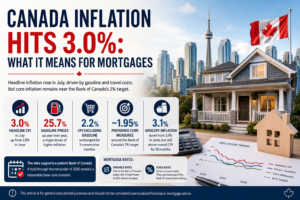
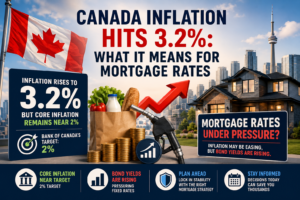
CPI inflation has recently been running around 3%, largely because of higher gasoline prices. The encouraging part is that inflation excluding gasoline was 2.2% in July, while the Bank’s preferred core inflation measures remained close to its 2% target.
In simple terms, the Bank doesn’t currently see enough weakness to justify another rate cut, but it also doesn’t see a clear reason to raise rates.
What Does This Mean for Canadian Mortgage Rates?
This is where borrowers need to separate variable and fixed mortgage rates.
Variable Mortgage Rates
Variable-rate mortgages are closely connected to lenders’ prime rates, which are influenced by the Bank of Canada’s policy rate.
Because the Bank held at 2.25%, borrowers shouldn’t expect an immediate Bank-of-Canada-driven change to variable mortgage rates.
The policy rate has now remained at 2.25% since the Bank’s October 2025 rate cut.
Fixed Mortgage Rates
Fixed mortgage rates are a different story.
They are influenced more heavily by government bond yields than by the Bank of Canada’s overnight rate. The Bank noted that long-term bond yields have increased globally, including in Canada.
That means the Bank can leave its rate unchanged while lenders still adjust fixed mortgage rates.
The important takeaway: A Bank of Canada rate hold does not guarantee that today’s fixed mortgage rates will still be available several weeks from now.
What Does This Mean for Homebuyers?
For buyers waiting for significantly lower mortgage rates before entering the market, the path forward has become less certain.
Canada’s housing market has shown some improvement after several weak quarters, but affordability remains a challenge in many markets. At the same time, stronger economic growth and renewed inflation risks could make additional Bank of Canada cuts less likely in the near term.
Rather than trying to perfectly time the next rate move, buyers may benefit from focusing on what they can control:
- their monthly payment and overall budget;
- the mortgage amount they comfortably qualify for;
- fixed versus variable options;
- prepayment flexibility and penalties; and
- whether a rate hold is available while they shop for a home.
What About Homeowners Renewing Their Mortgage?
If your mortgage renewal is approaching, don’t assume waiting will automatically produce a lower rate.
The Bank of Canada’s next scheduled rate announcement is October 28, 2026, when it will also publish a new Monetary Policy Report.
Between now and then, bond yields, inflation expectations and economic data can all influence mortgage pricing.
This makes it worthwhile to review renewal options early and compare your existing lender’s offer with other available mortgage products.
The Bigger Picture
The Bank of Canada is effectively walking a narrow path.
Canada’s economy is recovering, but there is still excess capacity. Meanwhile, higher oil prices and new tariffs create the risk that businesses face higher costs and eventually pass some of those costs on to consumers.
If inflation stays concentrated in energy, the Bank may have room to remain patient.
If higher costs begin spreading across the economy, however, the conversation could shift from when rates might fall again to whether rates need to remain higher for longer—or eventually increase.
For mortgage borrowers, that makes flexibility more important than trying to predict the Bank’s next move.
Bottom Line
The Bank of Canada holding its policy rate at 2.25% provides some welcome stability, particularly for variable-rate borrowers.
But a rate hold isn’t the same thing as a mortgage-rate freeze.
Fixed mortgage rates can move independently as bond yields change, while future Bank of Canada decisions will depend heavily on inflation, economic growth, trade developments and energy prices.
If you’re buying a home, renewing a mortgage or considering a refinance, the better question isn’t simply, “Where are rates going?”
It’s “Which mortgage strategy works for me if rates don’t move the way I expect?”
That approach can help you make a sound financing decision without having to perfectly predict the next interest-rate announcement.
Frequently Asked Questions
What is the Bank of Canada interest rate now?
As of September 2026, the Bank of Canada’s target for the overnight rate is 2.25%. The rate has been at this level since October 2025.
Will variable mortgage rates change after this announcement?
There should be little immediate impact from the September decision because the Bank of Canada did not change its policy rate. Individual lender pricing can still vary.
Can fixed mortgage rates rise even when the Bank of Canada holds rates?
Yes. Fixed mortgage rates are influenced heavily by government bond yields and financial-market expectations. They can rise or fall without a Bank of Canada rate change.
Will the Bank of Canada cut rates again in 2026?
It’s possible, but far from guaranteed. Stronger economic growth and increased inflation risks make the outlook less clear. The Bank has said it will assess both the sustainability of Canada’s recovery and the inflation outlook before adjusting monetary policy.
When is the next Bank of Canada rate announcement?
The next scheduled Bank of Canada interest rate decision is October 28, 2026. A new Monetary Policy Report is also scheduled for that date.

Cedric Pelletier
Mortgage Associate – Maximal Mortgages