23 Jun

Canadian Inflation Climbs to 3.2% in May

General

Posted by: Cedric Pelletier

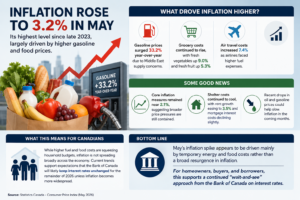
Key Takeaway: Inflation rose to 3.2% in May, its highest level since late 2023, largely driven by higher gasoline and food prices. However, underlying inflation remains relatively stable, reducing pressure on the Bank of Canada to raise interest rates.

What Drove Inflation Higher?

  • Gasoline prices surged 33.2% year-over-year due to Middle East supply concerns.
  • Grocery costs continued to rise, with fresh vegetables up 9.0% and fresh fruit up 5.3%.
  • Air travel costs increased 7.4% as airlines faced higher fuel expenses.

Some Good News

  • Core inflation measures remained near 2.1%, suggesting broader price pressures are still contained.
  • Shelter costs continued to cool, with rent growth easing to 3.5% and mortgage interest costs declining slightly.
  • Recent drops in oil and gasoline prices could help slow inflation in the coming months.

What This Means for Canadians

While higher fuel and food costs are squeezing household budgets, inflation is not spreading broadly across the economy. Current trends support expectations that the Bank of Canada will likely keep interest rates unchanged for the remainder of 2026 unless inflation becomes more widespread.

Bottom Line: May’s inflation spike appears to be driven mainly by temporary energy and food costs rather than a broad resurgence in inflation. For homeowners, buyers, and borrowers, this supports a continued “wait-and-see” approach from the Bank of Canada on interest rates.


Cedric Pelletier – Mortgage Associate
Maximal Mortgages

22 Jun

Canada’s Housing Market Gains Momentum for Summer 2026

General

Posted by: Cedric Pelletier


Key Takeaways

  • Home sales posted their strongest monthly gain of 2026 in May.
  • Home prices are stabilizing after months of declines.
  • Inventory remains balanced at 4.8 months nationally.
  • Lower borrowing costs are helping bring buyers back to the market.
  • Single-family homes are outperforming the condo sector.
  • The Bank of Canada is expected to remain on hold for now.

Why This Matters

After more than a year of uncertainty, Canada’s housing market appears to be shifting from stabilization into recovery. Lower mortgage rates, improved affordability, and more realistic pricing are encouraging buyers to re-enter the market.

For homebuyers, this could be a window of opportunity before competition increases further. For sellers, market conditions are becoming healthier and more balanced.

Sales Activity Continues to Improve

May delivered the strongest increase in home sales so far this year, signaling renewed confidence among buyers.

Several trends suggest momentum is building:

  • Stronger sale-to-list price ratios
  • Faster selling times
  • Slowing price declines
  • Improved affordability in many markets

Ontario and British Columbia, where prices have corrected the most, are seeing growing interest from buyers who have been waiting on the sidelines.

Inventory Remains Balanced

New listings fell 1% in May and were down nearly 8% from a year ago.

National inventory sits at just over 200,000 properties, slightly below long-term averages. Months of inventory declined to 4.8 months, close to the historical balanced-market level of five months.

This suggests neither buyers nor sellers currently hold a significant advantage nationally.

Home Prices Are Finding a Floor

The national MLS® Home Price Index slipped just 0.1% in May, the smallest monthly decline since late 2025.

Year-over-year prices remain down 4.2%, but the pace of decline continues to slow.

This stabilization is important because it helps restore confidence and encourages more market activity.

Condos Still Face Challenges

While detached homes continue to see solid demand, many condo markets remain under pressure.

Factors affecting condo demand include:

  • Higher ownership costs
  • Softer rental markets
  • Reduced investor activity
  • Slower population growth due to lower immigration targets

However, improving financing conditions should gradually support condo demand over time.

What Could Happen Next?

Housing conditions appear more favourable heading into summer.

Falling oil prices and easing bond yields may reduce inflation concerns and support lower borrowing costs. If inflation remains contained, the Bank of Canada is expected to keep rates unchanged through the remainder of 2026.

The biggest risk remains inflation. Stronger-than-expected inflation data could delay future rate cuts and temporarily slow housing activity.

Conclusion

Canada’s housing market is showing clear signs of improvement. Sales are rising, prices are stabilizing, and inventory remains balanced. While some regional and condo-market challenges persist, the overall trend suggests the market is regaining its footing.

For buyers, improving affordability and stable prices may create opportunities before activity accelerates further. For sellers, growing confidence and stronger demand could lead to better market conditions through the second half of 2026.

FAQ

Is Canada’s housing market recovering in 2026?

Yes. Rising sales, stabilizing prices, and balanced inventory levels suggest the market is moving from stabilization toward recovery.

Are home prices still falling?

Prices remain slightly below last year’s levels, but monthly declines have slowed significantly, indicating prices may be finding a floor.

Will mortgage rates fall in 2026?

While no outcome is guaranteed, markets currently expect the Bank of Canada to remain on hold, with future rate decisions depending largely on inflation data.

Is now a good time to buy a home in Canada?

Many buyers are benefiting from improved affordability, lower prices compared to peak levels, and less competition than during previous market cycles.


Cedric Pelletier – Mortgage Associate
Maximal Mortgages

12 Jun

Bank of Canada Holds Rate at 2.25%: What It Means for Canadian Borrowers

General

Posted by: Cedric Pelletier

Theme: Uncertainty is shaping Canada’s economy—and understanding interest rate risks can help Canadians make smarter mortgage decisions.

Key Takeaways

  • The Bank of Canada held its overnight rate at 2.25%.
  • Inflation remains above the Bank’s 2% target and could rise further if energy prices stay elevated.
  • Economic growth has weakened, creating a difficult balancing act for policymakers.
  • Future rate decisions could go in either direction depending on trade tensions, inflation, and global events.
  • Mortgage borrowers should prepare for a range of scenarios rather than assuming rates will only move lower.

Why the Bank of Canada Left Rates Unchanged

The Bank of Canada has chosen to keep its benchmark interest rate at 2.25%, marking its fifth consecutive rate hold.

While many Canadians have been hoping for additional rate cuts, the central bank is facing a complicated economic environment.

On one hand, Canada’s economy has slowed considerably. Recent GDP figures showed the economy contracted during the first quarter, following weakness in the previous quarter as well.

On the other hand, inflation remains stubbornly above target. Rising energy costs, partly linked to ongoing geopolitical tensions in the Middle East, are creating upward pressure on prices.

This combination of slower growth and persistent inflation puts the Bank of Canada in a difficult position.

The Policy Dilemma Explained

Normally, central banks use interest rates to achieve one primary goal:

  • Lower rates help stimulate economic growth.
  • Higher rates help reduce inflation.

Today’s challenge is that Canada is experiencing signs of both economic weakness and inflationary pressure simultaneously.

If the Bank cuts rates too quickly:

  • Consumer spending could increase.
  • Inflation could remain elevated.
  • Price growth could become more difficult to control.

If the Bank raises rates:

  • Inflation may cool.
  • Economic growth could slow further.
  • Borrowers could face higher debt costs.

This is the “policy dilemma” Governor Tiff Macklem referenced.


How Global Events Are Affecting Canada’s Interest Rate Outlook

Two major global risks are influencing the Bank’s thinking.

1. U.S. Trade Uncertainty

Canada’s economy remains heavily dependent on trade with the United States.

If new trade restrictions are introduced, Canadian exports could weaken further, putting pressure on economic growth.

In that scenario, the Bank of Canada could consider lowering rates to support the economy.

2. Rising Oil Prices and Middle East Conflict

Higher oil prices tend to push transportation, manufacturing, and consumer costs higher.

The Bank noted that oil prices have remained above earlier forecasts due to ongoing conflict in the Middle East.

If higher energy costs spread into broader inflation across the economy, policymakers may need to consider additional rate hikes.

This is why the Bank specifically warned that consecutive rate increases remain possible if inflation becomes more widespread.


What This Means for Mortgage Rates

Variable-Rate Mortgages

Variable mortgage rates are directly influenced by the Bank of Canada’s overnight rate.

Since the policy rate remains unchanged:

  • Existing variable-rate borrowers will likely see no immediate change.
  • Adjustable-rate mortgage payments should remain stable.
  • New variable-rate mortgage pricing will likely remain similar in the short term.

Fixed Mortgage Rates

Fixed mortgage rates are influenced more by bond yields than the Bank of Canada’s overnight rate.

Because financial markets were already expecting the rate hold, fixed mortgage rates may not move significantly based on this announcement alone.

However, inflation data and global economic developments could still affect bond markets and future fixed-rate pricing.


What Homebuyers Should Know

For prospective buyers, today’s announcement provides some short-term stability.

The Bank’s decision suggests policymakers are not rushing into either cuts or hikes.

That means:

  • Mortgage qualification costs remain relatively predictable.
  • Buyers can focus on affordability and budgeting rather than trying to time the market.
  • Future rate movements remain uncertain.

Instead of waiting for the “perfect” rate environment, buyers should focus on:

  • Their long-term housing goals
  • Monthly payment affordability
  • Emergency savings
  • Mortgage flexibility options

What Current Homeowners Should Consider

Homeowners approaching renewal should pay close attention to economic developments over the coming months.

The Bank of Canada’s message was clear: future decisions depend heavily on incoming data.

Consider:

If Inflation Stays Elevated

Rates could remain higher for longer, and further increases cannot be ruled out.

If Economic Growth Weakens Further

Rate cuts may return to support the economy.

If Global Risks Escalate

Market volatility could increase, affecting both fixed and variable mortgage pricing.

For many borrowers, reviewing renewal options several months before maturity may provide more flexibility and negotiating power.


Looking Ahead: What Could Trigger the Next Rate Move?

Several indicators will likely influence future Bank of Canada decisions:

  • Inflation trends
  • Core inflation measures
  • Employment data
  • GDP growth
  • Oil prices
  • U.S.-Canada trade developments
  • Consumer spending activity

The central bank appears willing to remain patient while monitoring these factors.

For now, the most likely outcome is a period of stability, but Canadians should not assume rate cuts are guaranteed.


Conclusion

The Bank of Canada’s latest decision highlights the uncertainty facing Canada’s economy.

While growth has slowed, inflation risks have not disappeared. This leaves policymakers balancing two competing priorities: supporting economic activity while preventing inflation from becoming entrenched.

For homebuyers, homeowners, and mortgage borrowers, the key takeaway is simple: build flexibility into your financial plans. The next move from the Bank of Canada could depend on events both at home and abroad.

Rather than trying to predict every rate announcement, focus on affordability, cash flow, and long-term financial stability.


5. FAQ Section

Why did the Bank of Canada keep rates at 2.25%?

The Bank believes holding rates currently balances the risks of weak economic growth and elevated inflation.

Will mortgage rates go down soon?

There is no guarantee. Future rate cuts depend on inflation, economic growth, and global developments.

Could the Bank of Canada raise rates again?

Yes. The Bank indicated that consecutive rate increases could be necessary if higher energy prices create broader inflation pressures.

How does the Bank of Canada rate affect mortgages?

The overnight rate directly influences variable-rate mortgages and indirectly affects fixed mortgage rates through market expectations and bond yields.

Is now a good time to buy a home in Canada?

The answer depends on your finances, affordability, and long-term plans. Stable rates provide some certainty, but buyers should focus on personal readiness rather than attempting to time the market.


Cedric Pelletier – Mortgage Associate
Maximal Mortgages – Dominion Lending Centre

29 May

Canada’s Weak Job Market May Not Lead to Rate Cuts

General

Posted by: Cedric Pelletier

Canada’s economy lost 17,700 jobs in April, while the unemployment rate climbed to 6.9%, its highest level in six months. Normally, weaker employment data would strengthen the case for interest rate cuts.

However, rising oil prices are complicating the outlook.

Key Takeaways

  • Canada lost jobs and unemployment increased.
  • Economic weakness typically supports lower interest rates.
  • Rising oil prices are creating inflation concerns.
  • The Bank of Canada is still expected to hold rates steady in the near term.
  • Mortgage rates may stay higher for longer.

Why It Matters

A softer labour market suggests inflation pressures could ease as hiring slows and consumer spending weakens. But higher energy costs can push inflation higher, making it harder for the Bank of Canada to justify cutting rates.

This puts policymakers in a difficult position: support a slowing economy or continue fighting inflation.

Impact on Mortgage Borrowers

Variable-Rate Mortgages

Variable rates depend on Bank of Canada decisions. For now, markets expect the central bank to leave rates unchanged.

Fixed Mortgage Rates

Fixed rates are influenced by bond yields and inflation expectations. Rising oil prices could keep upward pressure on yields, limiting rate declines.

The Bottom Line

Canada’s latest jobs report points to a slowing economy, but inflation remains the key concern. As long as oil prices stay elevated, the Bank of Canada may be reluctant to lower rates quickly.

For homeowners, buyers, and borrowers, that means planning for a higher-rate environment may still be the safest approach.

FAQ

Will Canada cut rates soon?

Not necessarily. Weak employment supports cuts, but inflation risks from higher oil prices could delay them.

How do oil prices affect interest rates?

Higher oil prices can increase inflation, making central banks more cautious about lowering rates.

What does this mean for mortgages?

Mortgage rates may remain relatively stable or higher than expected until inflation pressures ease.


Cedric Pelletier – Mortgage Associate – 05.2026

20 May

Canada’s Core Inflation Nears 2%: What It Means for Mortgage Rates

General

Posted by: Cedric Pelletier


Canada’s latest inflation report delivered encouraging news for mortgage borrowers.

Headline inflation rose 2.8% in April, but the more important number was core inflation, which fell to:

2.05%2.05\%

That’s very close to the Bank of Canada’s 2% target and the lowest level since 2021.

Key Takeaways

  • Core inflation cooled significantly in April
  • Gas prices were the main reason headline inflation stayed elevated
  • Mortgage interest costs fell for the first time since 2022
  • Rent growth continues slowing
  • Markets still expect possible rate hikes later this year
  • Variable-rate borrowers may get some relief

What’s Driving Inflation Right Now?

Most of April’s inflation increase came from gasoline prices, which jumped sharply year-over-year.

But outside of energy, inflation was much softer:

  • CPI excluding food, energy, and indirect taxes was 1.5%
  • Rent inflation slowed to its weakest pace in four years
  • Mortgage interest costs declined year-over-year

These are signs that higher interest rates are continuing to cool the economy.


Why Markets Still Expect Rate Hikes

Even with softer inflation data, markets are still pricing in possible Bank of Canada hikes later this year.

One reason is inflation breadth — the share of prices still rising above 3%. That figure increased to:

40.4%40.4\%

This suggests inflation pressures haven’t fully disappeared across the economy.

Still, many economists believe the Bank of Canada will likely hold rates steady unless inflation starts rising again.


What This Means for Mortgage Borrowers

Variable-Rate Mortgages

This report is positive for variable-rate borrowers.

If core inflation stays near 2%, pressure for additional rate hikes may ease, giving homeowners more stability.

Fixed Mortgage Rates

Fixed rates remain tied to bond yields, especially in the U.S.

That means fixed mortgage pricing could still fluctuate even as Canadian inflation improves.


The Bottom Line

Canada’s inflation picture is improving beneath the surface.

Core inflation is close to target, rent growth is slowing, and mortgage interest costs are finally easing.

While markets still see some risk of future hikes, this report gives borrowers cautious optimism that rate pressures may be starting to stabilize.

FAQ Section

What is core inflation?

Core inflation removes volatile items like food and energy to show underlying inflation trends more clearly.

Will the Bank of Canada raise rates again?

Markets still expect possible hikes, but many economists believe rates could remain unchanged if inflation continues cooling.

Is this good news for mortgage borrowers?

Yes. Softer inflation reduces pressure for future rate hikes and may help stabilize borrowing costs.


Cedric Pelletier – Written by the Marketing team at MLN

14 May

Canada Housing Market Stabilizing in Spring 2026

General

Posted by: Cedric Pelletier

Canada’s Housing Market Showing Signs of Stability

Canada’s housing market showed modest improvement in April 2026, with home sales rising 0.7% month-over-month according to CREA. While activity remains softer than normal, improving buyer demand and stabilizing prices suggest the market may be finding its footing heading into spring.

Key Takeaways

  • Home sales increased slightly in April
  • New listings jumped 4.1%
  • National home prices declined just 0.1%
  • Inventory levels remain balanced nationally
  • Inflation and interest rate uncertainty continue to impact buyers

More Listings, More Balance

Spring listings picked up across Canada in April, giving buyers more options and easing pressure in many markets.

The national sales-to-new listings ratio fell to 45.6%, putting Canada near balanced market territory. Inventory also increased to 5.2 months nationally, which is considered a healthy level overall.

For buyers, this means:

  • More negotiating power
  • Less competition
  • More time to make decisions

Home Prices Are Stabilizing

The National Composite MLS® Home Price Index slipped just 0.1% in April — the smallest monthly decline since October 2025.

Year-over-year prices remain down 4.2%, but the pace of decline is slowing, which could help bring more buyers back into the market.

Ontario continues to see the biggest pressure, especially in condo-heavy regions dealing with excess supply.

What About Interest Rates?

Rising oil prices and ongoing geopolitical tensions are creating inflation concerns globally. That could make future Bank of Canada decisions more complicated.

While rates have remained unchanged so far in 2026, another hike cannot be ruled out if inflation stays elevated.

Bottom Line

Canada’s housing market is not booming, but conditions are improving gradually.

With stabilizing prices, healthier inventory, and cautious buyer demand returning, spring 2026 may mark the beginning of a slower, more balanced recovery.


FAQ

Are home prices still falling in Canada?

Yes, but price declines are slowing significantly compared to earlier this year.

Is Canada in a buyer’s market?

Nationally, conditions are closer to balanced, though some regions favor buyers more than others.

Will mortgage rates rise again?

It’s possible if inflation remains high, although the Bank of Canada is still proceeding cautiously.

9 May

Renewing Your Mortgage but Planning to Sell Soon?

General

Posted by: Cedric Pelletier

If your mortgage renewal is coming up and you may sell your home within the next 12 months, do not focus only on the lowest rate.

Flexibility may matter more.

Many Canadian homeowners renew into a fixed-rate mortgage because it feels safe. But if you sell shortly after renewing, you may need to break that mortgage early. That can lead to costly mortgage penalties, especially with some fixed-rate products.

Key Takeaways

  • Selling soon? Prioritize flexibility over the lowest rate.
  • Fixed-rate mortgages can trigger large penalties if broken early.
  • Variable-rate mortgages often have more predictable penalties.
  • A HELOC may work as a short-term option before selling.
  • Do not rush into an early renewal just because your lender calls.

Why Fixed Rates Can Be Risky Before Selling

A fixed-rate mortgage can be a good choice if you plan to stay in your home for the full term.

But if you renew into a fixed mortgage and sell soon after, your lender may charge a prepayment penalty. This may include an interest rate differential, often called an IRD penalty.

An IRD penalty can be much higher than three months’ interest, depending on your lender, rate, balance, and time left in the term.

That is why a fixed rate may not be the safest choice if your selling timeline is uncertain.

Why Variable Rates May Offer More Flexibility

A variable-rate mortgage may be a better fit if you plan to sell soon.

Many closed variable-rate mortgages use a penalty based on three months’ interest. That can make the cost of breaking the mortgage easier to predict.

Variable rates can move up or down, so they are not risk-free. But for a short period before selling, the penalty savings may matter more than small rate changes.

Could a HELOC Be a Good Short-Term Option?

A Home Equity Line of Credit, or HELOC, may also help if you are confident you will sell soon.

A HELOC can offer:

  • Flexible repayment
  • Interest-only payment options
  • No typical fixed mortgage break penalty
  • More control over your timeline

However, a HELOC is not right for everyone. You need enough home equity and must qualify with the lender. In Canada, the revolving HELOC portion is generally limited to 65% of your home’s value.

Should You Renew Early?

Be careful with early renewal offers.

Banks often contact borrowers before maturity. That does not mean you need to sign right away.

If your home may sell before or shortly after renewal, ask about:

  • Open mortgage options
  • Short-term mortgage options
  • Variable-rate options
  • HELOC options
  • Waiting until closer to maturity

The goal is to avoid locking into a long-term mortgage when you may only need short-term financing.

Questions to Ask Before Signing

Before renewing, ask:

  1. What would my penalty be if I sell within 6 to 12 months?
  2. How is the penalty calculated?
  3. Can I move this mortgage to another property?
  4. Is there an open or short-term option?
  5. Would a HELOC work for my situation?

Get the answers in writing where possible.

Bottom Line

If you are renewing your mortgage but planning to sell soon, the best mortgage may not be the one with the lowest rate.

It may be the one with the most flexibility.

Before you renew, compare fixed, variable, HELOC, and open mortgage options. A smart renewal decision today could help you avoid thousands of dollars in penalties later.

FAQ Section

Is it bad to renew my mortgage if I plan to sell?

No, but you should avoid a mortgage that creates a large penalty if you sell soon.

What mortgage is best if I am selling within 12 months?

A HELOC, variable-rate mortgage, open mortgage, or short-term mortgage may be better than a long fixed term.

Can I sell right after renewing my mortgage?

Yes, but you may have to pay a mortgage prepayment penalty.

Why are fixed mortgage penalties expensive?

Some fixed mortgages use an IRD penalty, which can be higher than three months’ interest.

Are variable mortgage penalties lower?

Often, yes. Many variable-rate mortgages charge three months’ interest, but always confirm with your lender.

Should I accept my bank’s early renewal offer?

Not automatically. Review your selling timeline, penalty risk, and other options first.

7 May

Have you had a mortgage check-up lately?

General

Posted by: Cedric Pelletier

Have you had a mortgage check-up lately?

Most people review their car insurance, phone bill, or subscriptions more often than they review the biggest debt they will ever carry: their mortgage.

A mortgage check-up can help you understand:

✅ If your current rate is still competitive
✅ If your renewal strategy makes sense
✅ If refinancing could improve your monthly cash flow
✅ If debt consolidation could save you money
✅ If your mortgage still fits your long-term goals
✅ If your penalty, prepayment privileges, and structure are working for you

Your bank may not call you when there is an opportunity to save money — but a good mortgage broker should help you stay proactive.

Whether you are renewing soon, thinking about refinancing, planning to buy, or just wondering if your current mortgage is still the right fit, I can help review your options.

Work with a St. Albert mortgage broker and Edmonton mortgage broker who works for you — not the bank.

Book your free mortgage check-up today.

Cedric Pelletier
Mortgage Broker | Maximal Mortgages
Dominion Lending Centres

30 Apr

Implied Cuts are Dead. A Summer Hike: Very Much Alive

General

Posted by: Cedric Pelletier

Bond yields rocketed higher on Wednesday as oil prices surged and central banks signalled a growing willingness to tighten if inflation broadens.

Markets are now aggressively repricing policy expectations—most notably in Canada, where rate cuts have vanished without a forwarding address, and a summer hike is back in play.


Yield Movers

Wednesday’s news flow drove yields:

  • Higher: The BoC maintained its 2.25% overnight rate for the fourth straight meeting, right on cue.  The central bank sees “little evidence” of high oil prices driving persistent inflation, but that’s only because oil shocks can take multiple months to filter through to core prices. Governor Macklem warned that if price increases become more widespread, “there may be a need for consecutive increases in the policy rate.” MLN provided the rate context here.

Canadian and U.S. Policy Rates
Apr 21Apr 260.00%2.50%5.00%

Overnight Target
Fed Funds Target


  • Higher: As unanimously predicted, the Fed left its policy target at 3.50% to 3.75%, though the decision was the most divided in decades. Three policymakers objected to the “inclusion of an easing bias in the statement at this time.”  MLN unpacked that news here.
    ​ ​ ​
  • Higher: WTI prices ripped higher yet again, with spot WTI crude up 6.8% to $110.47 on deadlocked U.S.-Iran negotiations. Crude looks destined for multi-year highs, barring divine intervention. Oil has rallied almost nonstop since April 17, when Trump said the Strait of Hormuz was “fully open and ready for business and full passage,” a statement that aged about as well as you’d expect.
    ​ ​ ​
    News also broke that Trump met with top oil firms about the possibility that the blockade could last months. “They discussed the steps President Trump has taken to alleviate global oil markets ​and steps we could take to continue the current blockade for months if needed and minimize ⁠impact on American consumers,” said the White House.

    “Oil is driving the repricing in the rates curve. The market is highly concerned that the U.S. is committed to a long-term blockade.”

    –Adam Button | chief currency analyst, investingLive

  • Higher: U.S. core capital goods orders increased 3.3% in March, shattering forecasts (est. +0.5%, prior +0.7%). The AI investment boom continues to bolster business spending on equipment and infrastructure.
    ​ ​ ​
    “The stunning degree ⁠of strength during a month when firms would have had valid reason to be cautious attests to the substantial energy in business investment that was bottled up last year due to policy-related uncertainty,” noted Stephen ​Stanley, Santander U.S. Capital Markets.

Curve Chronicles

Today’s mortgage headline is the abrupt shift in policy expectations for the Bank of Canada.

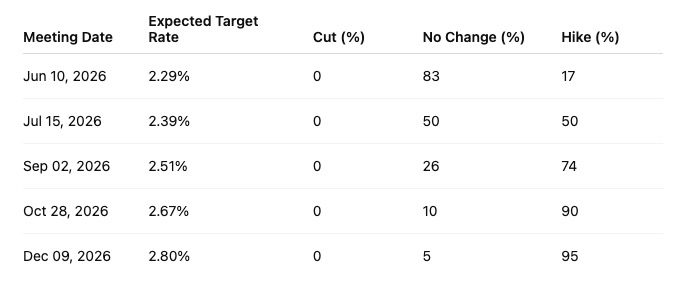
OIS traders have completely erased rate-cut odds and are now eyeing a 50% chance of a July hike. All markets needed was a reminder from the BoC that a tightening bias is possible.

Source: LSEG (NOT FOR REPUBLICATION)
OIS-implied BoC Policy Rate Path (Source: LSEG) — NOT FOR REPUBLICATION

Expect the outlook to swing wildly over the coming weeks as markets digest Trump’s war moves and as energy costs work their way through the system.

For now, though, the direction is clear: a surging CPI is bullish for the mortgage rate outlook, and that’s exactly the kind of clarity borrowers were hoping to avoid.


Quote Board

The 5-year yield is opening 2 ticks lower this morning at 3.24%.

Funding cost indicators closed strongly higher on Wednesday:

Policy Probabilities

Here’s how markets are pricing in future policy this morning:

  • For the Bank of Canada meeting on June 10:
    • 25 bps hike: 18% chance
    • No change: 82% chance
  • For the Federal Reserve meeting on June 17:
    • 25 bps cut: 4% chance
    • No change: 96% chance

Written by the team at MLN

26 Apr

Cedric Pelletier – BNI Feature Presentation

General

Posted by: Cedric Pelletier

Excited to announce our next Feature Speaker at BNI Revolution – Sherwood Park!

This Tuesday, we’re learning from Cedric Pelletier, Mortgage Associate with the Maximal Mortgages Team – Part of the DLCG, The #1 Mortgage funding company in Canada.

Cedric will be the value add he brings to the table as a broker, and how he can help people save thousands.

If you’re looking to expand your knowledge, grow your network, or simply connect with driven professionals to grow your business with referral, this is your opportunity!

📅 Tuesday, April 28
💻 Online Meeting — open to all ⏰ 11:30 AM start
Come ready to learn, connect, and grow.

DM for a link to join!