
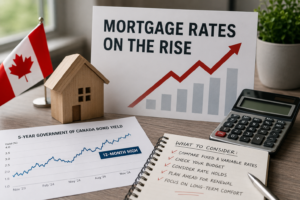
Canadian fixed mortgage rates are moving higher again as rising global bond yields increase borrowing costs for lenders.
The five-year Government of Canada bond yield has moved toward a 12-month high, prompting many lenders to increase three- to five-year fixed mortgage rates.
For Canadians buying a home or renewing a mortgage, the key point is simple:
Fixed mortgage rates can rise even when the Bank of Canada doesn’t change its policy rate.
Key Takeaways
- Rising bond yields are putting upward pressure on Canadian fixed mortgage rates.
- Fixed rates and Bank of Canada rates do not always move together.
- Variable mortgage rates are more directly influenced by the Bank of Canada.
- Global debt, inflation and geopolitical uncertainty are contributing to higher bond yields.
- Borrowers should choose a mortgage based on their budget and risk tolerance, not just predictions about where rates are headed.
Why Are Canadian Fixed Mortgage Rates Rising?
Fixed mortgage rates are closely connected to government bond yields.
For example, the five-year Government of Canada bond yield is an important benchmark for five-year fixed mortgage pricing.
When bond yields rise, lenders may face higher funding costs. Those costs can eventually be passed along to borrowers through higher fixed mortgage rates.
Recently, lenders have increased many three- to five-year fixed rates by roughly 0.10 to 0.20 percentage points.
That may sound small, but even modest rate increases can make a noticeable difference to monthly mortgage payments.
What’s Pushing Bond Yields Higher?
Several global forces are putting pressure on bond markets.
One of the biggest is government debt.
U.S. federal debt has surpassed US$40 trillion, while other major economies are also dealing with large government deficits and borrowing requirements.
Investors are also concerned about persistent inflation and geopolitical conflicts that could keep energy prices elevated.
When investors see more inflation or financial risk ahead, they generally demand higher yields to hold long-term bonds.
Because Canadian financial markets are closely connected to global markets, particularly the United States, rising U.S. Treasury yields can put upward pressure on Canadian bond yields as well.
Fixed vs. Variable: Why the Difference Matters
Fixed and variable mortgage rates are influenced by different parts of the financial system.
Fixed mortgage rates are largely influenced by bond yields and lender funding costs.
Variable mortgage rates are more directly connected to lender prime rates and the Bank of Canada’s policy rate.
That means fixed mortgage rates can rise while variable rates remain relatively stable.
This can make variable mortgages look more attractive, but they come with a different risk: if the Bank of Canada raises rates in the future, variable borrowing costs could increase.
Which mortgage should you choose?
A fixed mortgage may be worth considering if predictable payments and protection against higher rates are priorities.
A variable mortgage may make sense if you have more flexibility in your budget and can comfortably handle potential rate increases.
The important question isn’t simply “Which rate is lower today?”
It’s “Which mortgage can I comfortably manage if rates move against me?”
What This Means for Homebuyers and Renewals
If you’re buying a home or renewing a mortgage soon, rising bond yields are worth watching.
You may want to:
- Ask about a mortgage rate hold if you’re actively buying or approaching renewal.
- Compare fixed and variable options rather than assuming one is automatically better.
- Test your budget against higher-rate scenarios.
- Start shopping for a renewal early instead of automatically accepting your lender’s offer.
- Compare mortgage features and penalties along with the interest rate.
Trying to perfectly time the bottom of the mortgage market is difficult. Bond markets can move quickly, and lenders can adjust fixed rates before economic conditions appear to have changed significantly.
The Bottom Line
Rising Canadian fixed mortgage rates are another reminder that the Bank of Canada is only one part of the mortgage-rate story.
Global government debt, inflation expectations, energy prices and geopolitical uncertainty can all influence bond yields — and ultimately the fixed mortgage rates Canadians are offered.
If you’re buying, refinancing or renewing, focus less on predicting exactly where rates will go and more on choosing a mortgage that fits your financial situation.
A good mortgage strategy should still work even if interest rates don’t move the way you expected.
This article is for general educational purposes and is not personalized mortgage or financial advice.
FAQ
Why are Canadian fixed mortgage rates going up?
Fixed mortgage rates are rising because Government of Canada bond yields have increased. Higher bond yields can increase lenders’ funding costs and lead to higher fixed mortgage pricing.
Does the Bank of Canada control fixed mortgage rates?
Not directly. Bank of Canada decisions have a stronger direct influence on variable mortgage rates. Fixed rates are more closely connected to bond markets.
Should I choose a fixed or variable mortgage right now?
It depends on your finances and comfort with risk. Fixed mortgages provide payment certainty, while variable mortgages can offer different pricing but expose borrowers to future Bank of Canada rate changes.
Should I lock in a mortgage rate?
If you’re buying or renewing soon, asking about a rate hold may be worthwhile when fixed rates are rising. Compare the rate, term, penalties and mortgage features before making a decision.

Cedric Pelletier
Mortgage Associate – Maximal Mortgages