
Canada’s inflation rate moved higher in July, but the headline number doesn’t tell the whole story.
The Consumer Price Index (CPI) rose 3.0% year over year in July, up from 2.8% in June. While that might sound like inflation is heating up again, much of the increase came from gasoline and travel costs.
For Canadian homeowners, homebuyers and anyone approaching a mortgage renewal, the more important question is whether inflation is becoming widespread—or if this is a temporary bump.
Key Takeaways
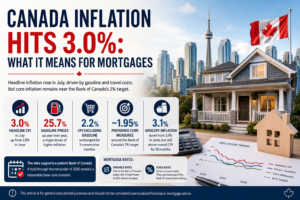
- Headline inflation increased to 3.0% in July.
- Gasoline prices jumped 25.7% year over year, helping push CPI higher.
- CPI excluding gasoline remained much lower at 2.2%.
- The average of the Bank of Canada’s preferred core inflation measures was about 1.95%.
- Grocery inflation slowed to 3.1%, although food costs continue to pressure household budgets.
- The report does not necessarily signal an immediate Bank of Canada rate increase.
Why Did Inflation Rise?
According to Statistics Canada, gasoline was one of the biggest drivers of July’s higher inflation reading.
Gas prices increased 25.7% c
ompared with a year earlier, partly due to geopolitical tensions and disruptions affecting global energy and shipping routes.
Travel also became more expensive. Travel tour prices increased 15.2% year over year, while air transportation prices rose 12.0%.
But when gasoline is removed from the calculation, inflation was just 2.2%—the same rate for three consecutive months.
That distinction matters for interest rates.
Core Inflation Is the Number to Watch
The Bank of Canada doesn’t make interest-rate decisions based on headline CPI alone. It also looks closely at measures of core inflation, which help identify whether price increases are becoming persistent across the economy.
The average of the Bank’s preferred core measures came in around 1.95%, essentially in line with its 2% inflation target.
In simple terms:
Headline CPI: 3.0%
CPI excluding gasoline: 2.2%
Preferred core measures: about 1.95%
This suggests July’s higher inflation rate was driven more by specific categories than a broad resurgence in inflation.
What Does This Mean for the Bank of Canada?
For now, the numbers support a patient approach.
Higher gasoline prices reduce household purchasing power, but an energy-driven increase in inflation does not automatically require higher interest rates.
The Bank of Canada will be watching to see whether higher energy costs begin spreading into other areas of the economy.
If core inflation remains c
ontained and domestic demand continues to slow, the case for keeping the policy rate unchanged becomes stronger.
Based on the current data, a Bank of Canada hold through the remainder of 2026 remains a reasonable base-case scenario, although future inflation and economic reports could change that outlook.
What Does This Mean for Mortgage Rates?
The answer depends on the type of mortgage.
Variable Mortgage Rates
Variable mortgage rates are closely tied to the Bank of Canada’s policy rate.
If the Bank remains on hold, there would be no Bank of Canada-driven reason for variable mortgage rates to increase.
That could provide some stability for borrowers with variable-rate mortgages or those considering one.
Fixed Mortgage Rates
Fixed mortgage rates work differently.
They are influenced heavily by Government of Canada bond yields, which can move based on expectations for future inflation, economic growth and Bank of Canada policy.
This means fixed mortgage rates can rise or fall even when the Bank of Canada does nothing.
If markets view July’s inflation increase as temporary, upward pressure on fixed rates may be limited. If investors become concerned that inflation is becoming persistent, b
ond yields—and potentially fixed mortgage rates—could rise.
Grocery Inflation Is Slowing, But Canadians Still Feel It
There was some good news for household budgets.
Grocery prices increased 3.1% year over year in July, down from 3.9% in June.
However, grocery inflation has now exceeded overall CPI inflation for 18 consecutive months.
This helps explain why many Canadians may not feel much relief even when inflation indicators improve.
Remember: lower inflation does not mean prices are falling. It means prices are increasing more slowly.
For homeowners already dealing with mortgage payments, property taxes, utilities and insurance, those higher everyday costs still matter.
What Should Homeowners and Buyers Do?
Trying to perfectly predict the next mortgage-rate move is difficult.
Instead, focus on what you can co
ntrol.
If you’re buying a home, build your budget around a comfortable monthly payment—not the maximum mortgage you can qualify for.
If your mortgage is renewing, don’t automatically accept your lender’s first offer. Compare fixed and variable options, rates, penalties and prepayment privileges.
And if you’re deciding between fixed and variable, consider your risk tolerance, income stability and future plans, not simply which rate is lowest today.
Bottom Line
Canada’s 3.0% inflation reading looks more concerning at first glance than it does when you dig into the details.
Gasoline and travel costs were major contributors, while CPI excluding gasoline remained at 2.2% and underlying core inflation stayed around the Bank of Canada’s 2% target.
For mortgage borrowers, the key takeaway is simple:
Don’t make a major mortgage decision based on one inflation headline.
Watch the trend in core inflation, Bank of Canada policy and bond yields. Those indicators can provide a much clearer picture of where Canadian mortgage rates may be heading.
This article is for general educational purposes and should not be considered personalized financial or mortgage advice.
FAQ
Does 3.0% inflation mean mortgage rates will rise?
Not necessarily. The Bank of Canada looks at underlying inflation and broader economic conditions. Fixed mortgage rates also depend heavily on bond yields.
What is core inflation?
Core inflation measures attempt to identify persistent price pressures by reducing the impact of unusually volatile price movements. It can give policymakers a clearer view of the underlying inflation trend.
Should I choose a fixed or variable mortgage?
There is no single answer for every borrower. Fixed rates provide greater certainty, while variable rates provide more exposure to future Bank of Canada rate changes. Your budget and tolerance for changing payments should guide the decision.
Should I wait for mortgage rates to fall before buying?
Not necessarily. Rates are only one part of affordability. Home prices, inventory, income and your personal finances can also change while you wait.

Cedric Pelletier
Mortgage Associate
Maximal Mortgages 2026