
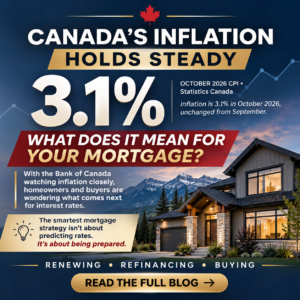
Canada’s inflation rate is holding steady, but that doesn’t mean mortgage rates are about to settle down.
According to Statistics Canada, annual inflation remained at 3.1% in October 2026, unchanged from September. Higher gasoline and grocery prices continue to put pressure on household budgets, even as some other costs ease.
Statistics Canada+1
For Canadian homeowners and homebuyers, the big question is simple: Will mortgage rates rise, fall, or stay where they are?
The answer depends on what happens next with inflation and the Bank of Canada’s interest rate decisions.
Key Takeaways
-
Canada’s annual inflation rate held at 3.1% in October 2026.
-
The Bank of Canada raised its policy interest rate to 2.5% in October.
-
Variable-rate mortgages are more directly affected by Bank of Canada rate changes.
-
Fixed mortgage rates depend more on bond markets and expectations about future interest rates.
-
Homeowners approaching renewal should compare options and prepare for different rate scenarios.
Why Is Canada’s Inflation Still at 3.1%?
Inflation measures how quickly prices are rising across the economy.
A 3.1% inflation rate doesn’t mean everything costs 3.1% more than last month. It means the overall Consumer Price Index was 3.1% higher than one year earlier.
In October, gasoline prices were up 30.9% compared with a year earlier, while grocery prices increased 2.0%. Excluding energy, inflation was a more moderate 2.0%.
Statistics Canada+1
That’s important because the Bank of Canada looks beyond the headline number to understand whether inflation is spreading throughout the economy.
What Does 3.1% Inflation Mean for Mortgage Rates?
The Bank of Canada aims to keep inflation near 2%.
When inflation remains elevated, the central bank may keep interest rates higher or raise them to slow spending and borrowing.
On October 28, 2026, the Bank of Canada increased its policy rate by 0.25 percentage points to 2.5%, warning that further increases could be needed if inflation pressures persist.
Bank of Canada
However, October’s steady inflation reading may give policymakers room to wait before making another move.
Variable-Rate Mortgages
Variable mortgage rates are generally tied to a lender’s prime rate, which is influenced by the Bank of Canada’s policy rate.
If the central bank raises rates, variable-rate borrowers may see higher payments or a larger share of their existing payment going toward interest, depending on their mortgage terms.
Fixed-Rate Mortgages
Fixed mortgage rates are more closely connected to Government of Canada bond yields.
Even if the Bank of Canada holds its policy rate steady, fixed mortgage rates can change as investors adjust their expectations for inflation and future interest rates.
The bottom line: A steady inflation rate does not guarantee steady mortgage rates.
What Could a Higher Mortgage Rate Cost You?
Consider a homeowner renewing a mortgage with a $400,000 balance and 25 years remaining on the amortization.
Illustrative monthly mortgage payments
Interest rate
4.50%
Estimated monthly payment
$2,223
Baseline example
Adjust the rate to see the payment impact. Estimates use monthly payments and Canadian semi-annual compounding for a fixed-rate mortgage. Excludes fees, insurance and property taxes.
Even a relatively small interest rate difference can affect your monthly budget.
Should You Renew Your Mortgage Now or Wait?
If your mortgage renewal is coming up, waiting for rates to fall could be risky.
Instead, consider three practical steps:
-
Review your renewal options early. Start comparing offers several months before your term ends.
-
Compare fixed and variable rates. Think about your comfort with payment changes, not just today’s advertised rate.
-
Stress-test your budget. Make sure your household can manage higher payments if rates move against you.
For Alberta homeowners, it’s also worth considering property taxes, insurance, utilities and other ownership costs when planning your renewal.
What Should First-Time Homebuyers Do?
Higher borrowing costs can reduce how much mortgage you qualify for, but that doesn’t mean buying a home is automatically the wrong decision.
Focus on your monthly affordability rather than trying to time the market perfectly.
A mortgage pre-approval, a realistic down payment plan and an emergency savings cushion can help you buy with greater confidence.
Remember, the best mortgage isn’t always the one with the lowest advertised interest rate. Prepayment privileges, penalties and flexibility also matter.
What’s Next for Canadian Interest Rates?
The Bank of Canada’s next scheduled interest rate announcement is December 9, 2026.
Policymakers will be watching inflation, employment, economic growth and whether higher energy costs are pushing up prices elsewhere.
Bank of Canada
A rate hold is possible, but another increase cannot be ruled out. Homeowners should plan for both possibilities rather than rely on a single forecast.
Frequently Asked Questions
Will mortgage rates go down if inflation falls?
Possibly, but not automatically. Lower inflation can make interest rate cuts more likely, while fixed mortgage rates also depend on bond yields and market expectations.
Is a fixed or variable mortgage better in 2026?
It depends on your budget and risk tolerance. Fixed rates provide payment stability during the term, while variable rates can offer savings if interest rates fall but carry the risk of increases.
How does inflation affect mortgage qualification?
Inflation can influence mortgage rates and everyday living costs. Higher interest rates may reduce the mortgage amount you qualify for under Canada’s mortgage stress-test rules.
Should I wait until 2027 to buy a home?
Not necessarily. Your income, down payment, affordability and long-term plans matter more than predicting exactly when interest rates will fall.
Final Thoughts: Focus on What You Can Control
Canada’s 3.1% inflation rate is a reminder that economic uncertainty hasn’t disappeared.
But you don’t need to predict the Bank of Canada’s next decision to make a smart mortgage choice.
Whether you’re buying your first home, renewing your mortgage or considering refinancing, understanding your options today can help protect your finances tomorrow.
Thinking about your next mortgage move? Connect with a mortgage professional to review your options and build a plan that fits your budget.

Cedric Pelletier
Mortgage Associate – Maximal Mortgages